
HUD Upgrades Are Redefining the Role of Automotive Transparent Materials
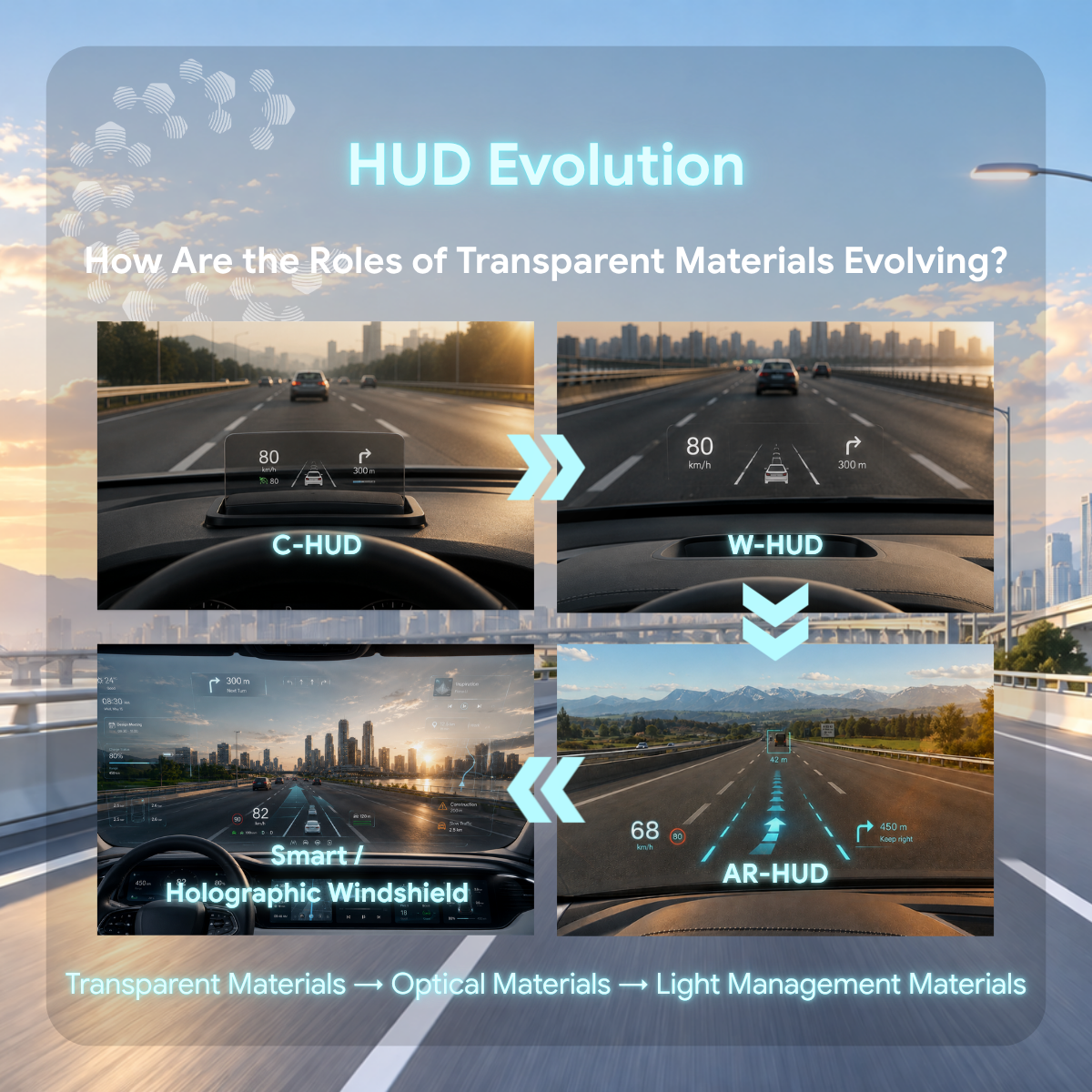
Driven by the rapid rise of smart cockpits and Advanced Driver Assistance Systems (ADAS), Head-Up Displays (HUD) have evolved beyond simple instruments showing speed, navigation, and alerts. Today, they serve as a primary visual bridge connecting the driver, the vehicle, and the surrounding road environment.
HUD technology has advanced from early Combiner HUDs (C-HUD) to Windshield HUDs (W-HUD)—which project virtual images directly onto the windshield—and further into Augmented Reality HUDs (AR-HUD) that align navigation cues, lane markings, and driver assistance overlays precisely with real-world road objects.
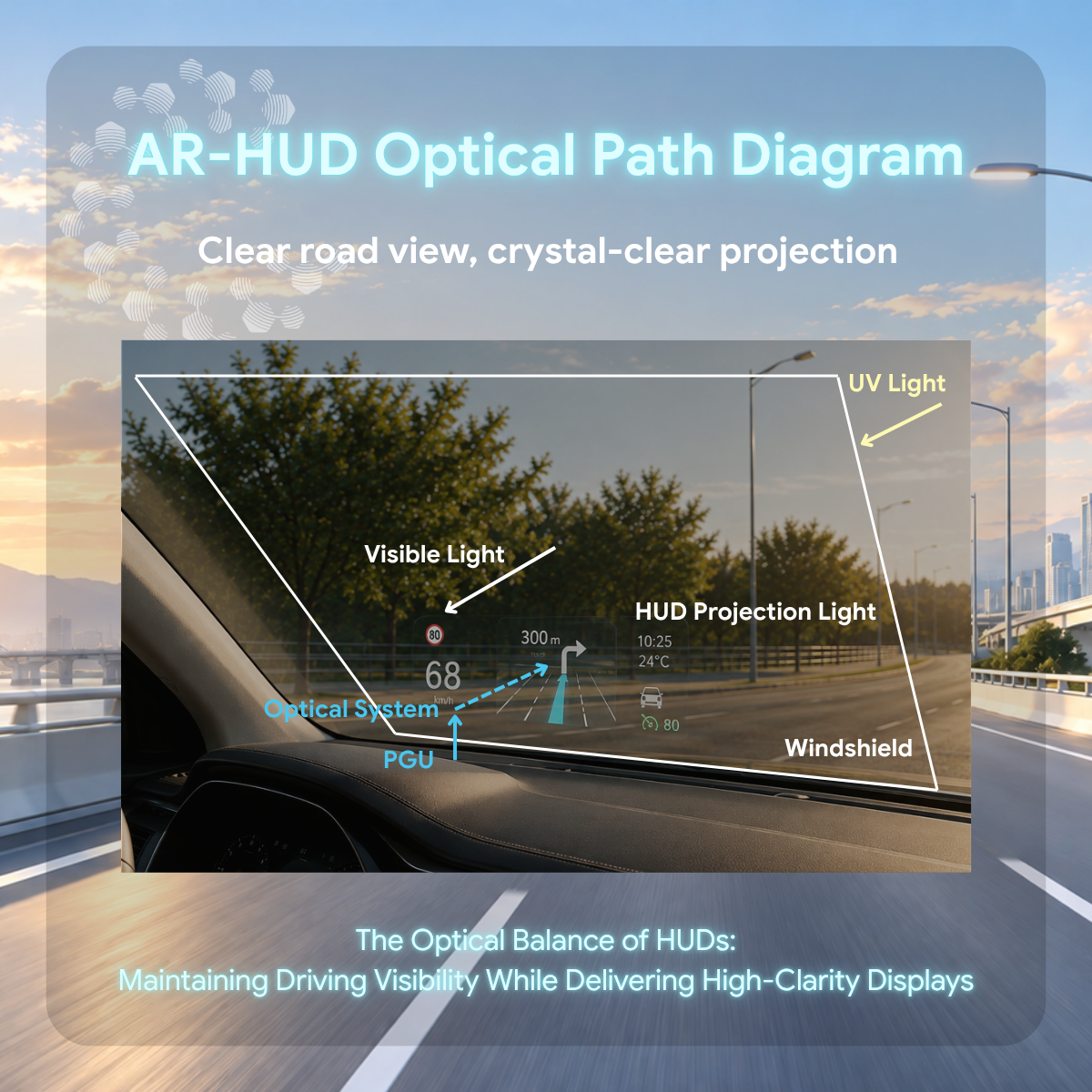
As windshields become active components in optical image formation, the demands on transparent materials are expanding. Beyond delivering high visible light transmittance and driving visibility, engineers must address optical reflection efficiency, ghost images, color fidelity, ambient light interference, and display light utilization.
Consequently, next-generation automotive transparent materials are shifting from simple "high-transparency substrates" to advanced "functional optical materials" capable of precise light management.
The Core Challenge of AR-HUDs: Balancing Transparency with Display Efficiency
What sets HUD optics apart is the requirement for drivers to view both projected virtual information and the real road environment simultaneously. As a result, windshields and integrated optical structures cannot simply boost HUD display reflection at the expense of ambient light transmission.
A 2025 study published in Optics & Laser Technology, titled A high-reflectivity double-layer liquid crystal polymer film for eliminating automotive head-up display ghost image, proposed a double-layer liquid crystal polymer film structure to solve this trade-off.
Under specific experimental setups, this film architecture achieved approximately 80% PGU light reflectivity while preserving over 70% ambient light transmission and maintaining a primary-to-secondary image intensity ratio of over 100:1.[1]
While these laboratory metrics may not apply universally to every AR-HUD or full-color RGB display system, they point to an unmistakable trend in material development:
Shifting from High Transparency to "Selective Spectral Management"
Selective Spectral Management refers to controlling light transmission, reflection, or absorption based on the distinct functional requirements of specific spectral bands within an optical system.
This approach has brought blue-band absorbing materials directly into the spotlight for HUD optical engineering.
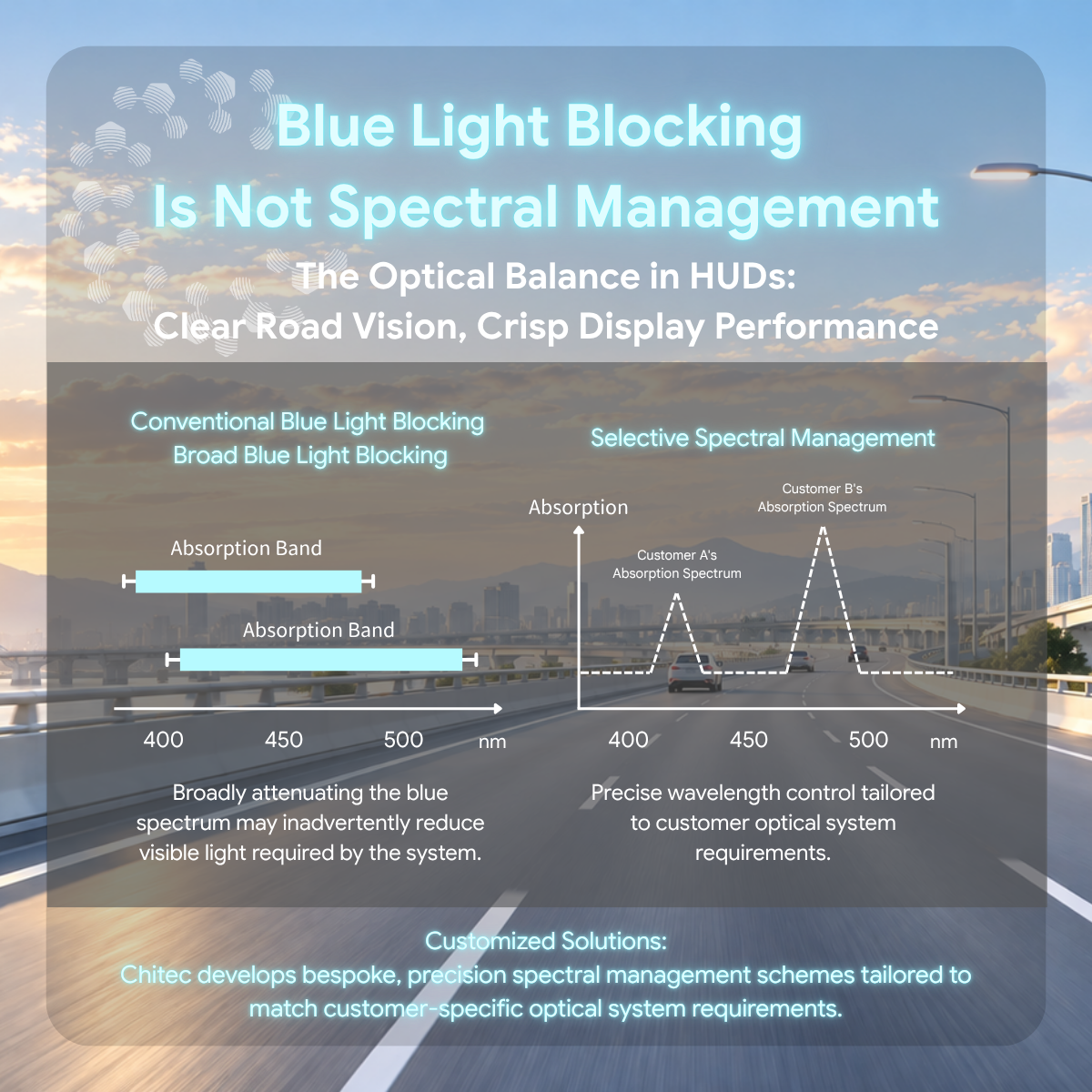
However, this strategy differs significantly from consumer-grade "blue light blocking" concepts. Because HUD displays rely on red, green, and blue (RGB) light to create full-color images, broad-spectrum blue light attenuation can degrade the blue channel's optical efficiency, reducing overall display brightness and color accuracy.
Therefore, when evaluating materials for high-precision optical systems like HUDs, industry focus must move beyond overall "blue light blocking rates" to evaluate: peak absorption wavelength (λmax), absorption bandwidth, absorption intensity, and spectral matching with the optical system's operating wavelengths.
HUD Patents Reveal Narrow-Band Blue Absorbers in Action
U.S. Patent Application Publication US20240027761A1, titled Systems and Methods for Stray Light Artifact Mitigation, details a holographic HUD windshield architecture where Holographic Optical Elements (HOE) are tailored specifically for red, green, and blue bands around 466 nm, 523 nm, and 623 nm.[2]
In such setups, specific wavelengths of external ambient light can interact with the HOE, creating unwanted reflections or stray-light artifacts. To mitigate this, the patent incorporates Narrow-Band Absorbers to selectively attenuate problematic ambient wavelengths.
In one embodiment, a blue-band absorber exhibits a peak absorption wavelength around 466 nm, a full width at half maximum (FWHM) of roughly 25 nm, and is compounded into a PVB interlayer at approximately 180 ppm.[2]
The significance of this design lies in its precision: rather than blocking blue light indiscriminately, the material's spectral profile is tuned to match the exact wavelengths requiring optical control.
In essence, these materials perform Narrow-Band Spectral Control.
For instance, a material absorbing mainly at 420–440 nm and another absorbing at 460–480 nm may show similar overall blue light absorption percentages, yet deliver vastly different optical outcomes in a specific HUD architecture.
This underscores why premium optical applications demand full UV-Vis spectral analysis rather than reliance on single-point blocking metrics.
Beyond Absorption Wavelength: Concentration, Transparency, and Color Balance
Even when a material's absorption band aligns with system specifications, loading concentration directly impacts final optical performance.
Increasing absorber concentration generally elevates target-band absorption; however, actual performance depends on intrinsic molar absorptivity, substrate thickness, formulation chemistry, and additive dispersion.
Excessive dosage or broad absorption bandwidths risk compromising total visible light transmittance (Tvis) or triggering unwanted color shifts and tint imbalances.
Consequently, optical material formulations for HUD applications must concurrently balance:
Success requires optimizing the system whole rather than maximizing single-band absorption.
Automotive Standards: Withstanding High Heat and Long-Term Weathering
Achieving target spectral properties is merely the entry ticket into the automotive supply chain.
Automotive windshields and transparent optical assemblies are subject to prolonged solar irradiation, elevated temperatures, humidity, and severe thermal cycling. As a result, absorbers must maintain their spectral integrity and visual clarity both during high-temperature processing and throughout extended field service.
Patent US20240027761A1 highlights key thermal stability considerations for narrow-band absorbers, noting requirements to withstand compounding conditions around 200°C and coating/glass lamination steps around 150°C.[2]
The patent further demonstrates pairing these absorbers with UV Absorbers (UVA), Hindered Amine Light Stabilizers (HALS), and Antioxidants (AO) to form robust stabilization packages capable of meeting automotive outdoor UV durability standards.[2]
This confirms that comprehensive automotive optical solutions rarely rely on a single additive.
Targeted spectral absorption, UV protection, light stabilization, and antioxidant defense must be engineered holistically.
Expanding Beyond PVB: Research Opportunities in Transparent Optical Media
While current HUD patents illustrate the integration of narrow-band absorbers into PVB interlayers and laminated glass, the underlying material concepts extend to broader transparent optical platforms.
Transparent polymer matrices, functional optical films, and hard coatings represent compelling avenues for future technical evaluation. However, each matrix requires independent validation across optical, processing, and durability parameters—data from PVB cannot simply be extrapolated to alternative resin systems.
Beyond spectral matching, formulation engineers must evaluate additive-matrix compatibility, dispersibility, thermal processing stability, and the risk of migration, blooming, or crystallization.
Haze control is particularly critical in HUD and smart windshield applications. Any additive crystallization, phase separation, or poor dispersion increases light scattering, directly compromising transparency and projected image crispness.
Ultimately, the commercial value of any functional absorber must be validated within the fully formulated, end-use material system.
From AR-HUD to Smart Windshields: The Era of Precision Light Management
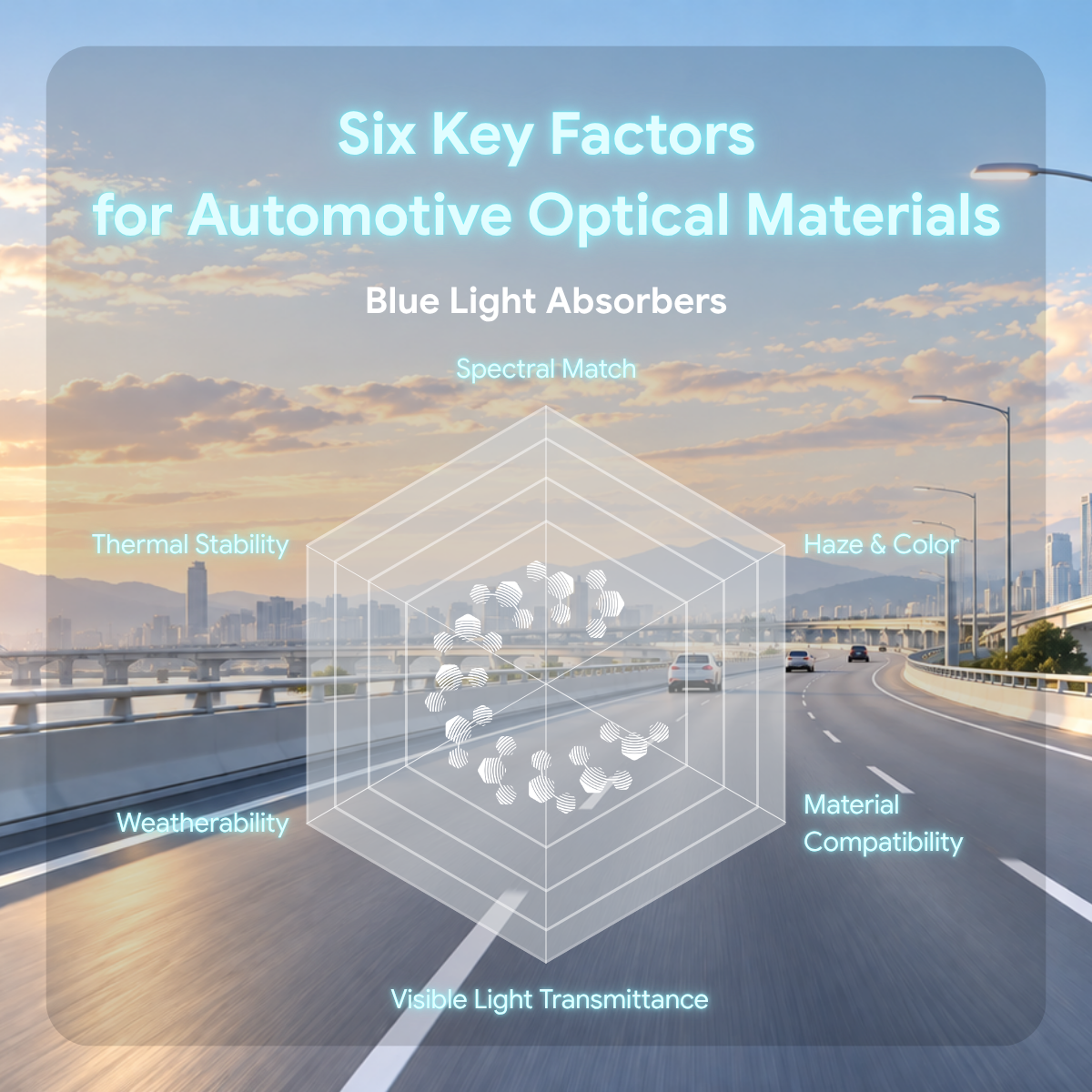
From W-HUD and AR-HUD to holographic displays and smart windshields, the functional expectations for automotive transparent materials are escalating rapidly.
Where materials once focused solely on maximizing visible light transmission, the core engineering question has evolved:
How can we achieve precise wavelength control without compromising overall transparency, color neutralness, or road visibility?
Emerging research and patent developments confirm that selective reflection and narrow-band absorption serve as powerful tools to optimize HUD display efficiency, manage ambient light, and eliminate stray-light artifacts.[1][2]
Blue Light Absorbers: Advancing from Blue Light Blocking to Spectral Management
In response to the growing demand for precision spectral control across HUDs, AR-HUDs, smart windshields, and optical film assemblies, specialized blue light absorbers offer tailorable absorption bands, substrate compatibility, and processing stability to assist customers in developing advanced formulations.
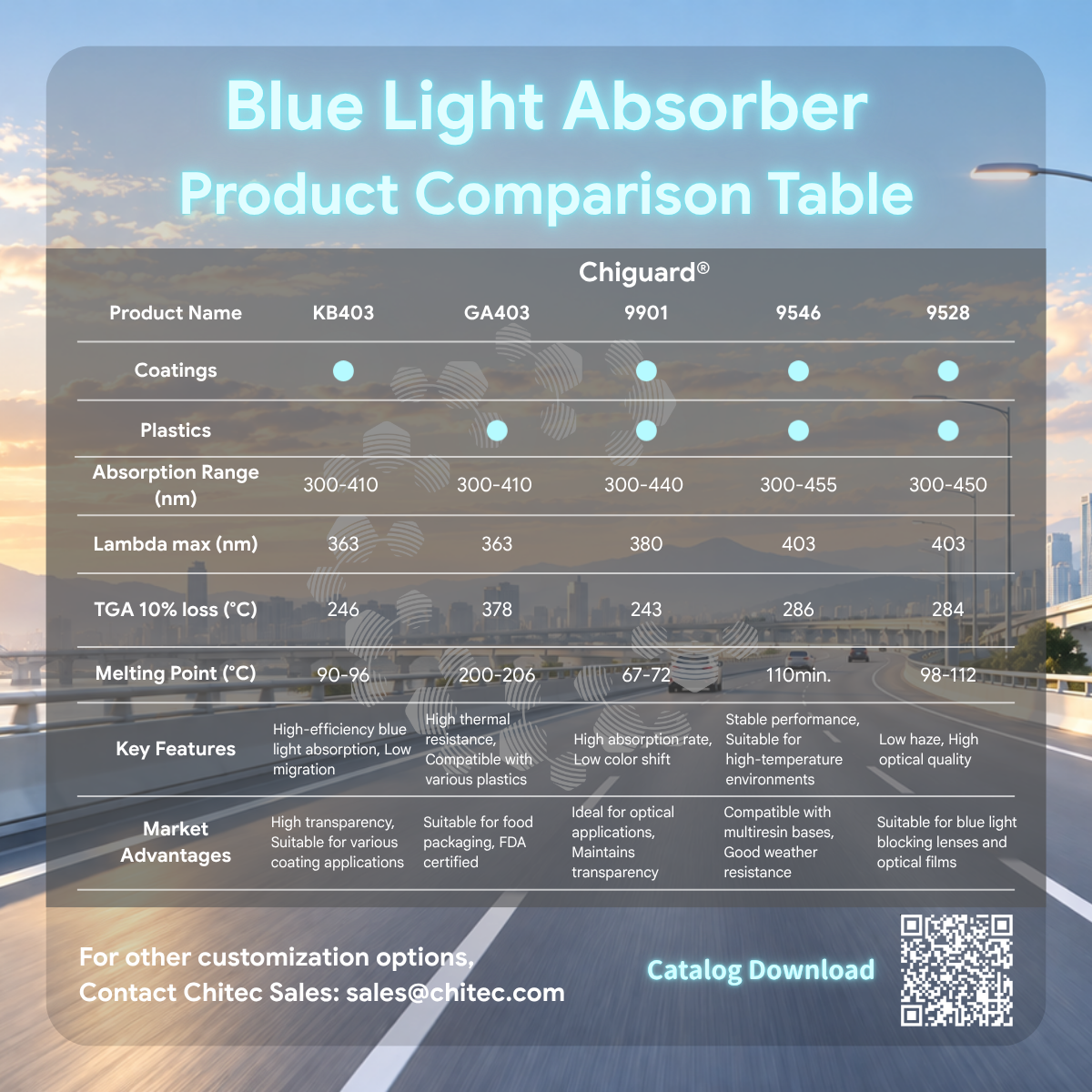
It is important to emphasize that not all conventional blue light absorbers are suitable for HUD applications.
For high-performance automotive optics, technical evaluation must encompass the complete UV-Vis spectrum, peak absorption wavelength, bandwidth, concentration-dependent transmission curves, overall visible light transmittance (Tvis), color coordinates, haze, resin compatibility, thermal stability, and long-term weatherability.
When engineering materials for next-generation HUD, holographic HUD, or smart glass projects, aligning the absorber's UV-Vis absorption profile with the specific wavelengths of the HUD light source and optical elements is essential for optimizing spectral match and application performance.
For material innovators, the central question is no longer "how much blue light can be absorbed," but rather:
Can target wavelengths be controlled with high precision while preserving transparency, color balance, processing stability, and outdoor durability?
This paradigm shifts the positioning of blue-band absorbing additives from traditional "blue light absorption" toward the cutting edge of automotive optics:
Selective Spectral Management
Look for Details? Contact us: sales@chitec.com
References
- Lv, Y. et al. “A high-reflectivity double-layer liquid crystal polymer film for eliminating automotive head-up display ghost image.” Optics & Laser Technology, Vol. 192, Part A, 2025, Article 113420. DOI: 10.1016/j.optlastec.2025.113420.
- U.S. Patent Application Publication US20240027761A1, Systems and Methods for Stray Light Artifact Mitigation. Discloses narrow-band absorbers for target RGB control in holographic HUD architectures, including ~466 nm peak absorption, ~25 nm FWHM, ~180 ppm loading in PVB interlayers, alongside thermal stability, UV durability, and light stabilization system design.
建議您使用以下瀏覽器觀看本網站,
要下載瀏覽器,請直接點擊以下:以獲得最佳瀏覽效果。