
The natural color, grain, and texture of wood are primary sources of value for furniture, flooring, doors, windows, cabinetry, and architectural wooden elements. However, these attractive natural aesthetics are inherently accompanied by one of the most frustrating challenges in long-term wood coating performance: discoloration.
Prolonged exposure to sunlight causes natural wood tones to gradually undergo yellowing, browning, darkening, fading, or color shift. When further exposed to outdoor environments, solar radiation acts synergistically with oxygen, moisture, temperature/humidity fluctuations, and other weathering factors, driving continuous wood degradation that leads to greying, surface roughening, loss of gloss, chalking, or cracking of the coating film.
This challenge is particularly severe for clear and semi-transparent wood coatings. The coating film must provide robust protection while preserving the underlying natural grain and color of the wood. Consequently, the true technical objective extends beyond simply "blocking UV light"—it requires managing complex photochemical and photo-oxidation reactions across the entire system: Coating Film → Coating/Wood Interface → Wood Substrate.
A 2025 review on clear water-based outdoor wood coatings highlighted that one of the core engineering challenges is simultaneously maintaining optical clarity, UV protection, water barrier properties, adhesion, and long-term durability. Achieving long-term weatherability in clear coatings remains significantly more difficult than in pigmented coating systems. ( ScienceDirect )
Why Does Wood Discolor? The Key Role of Lignin Photochemistry
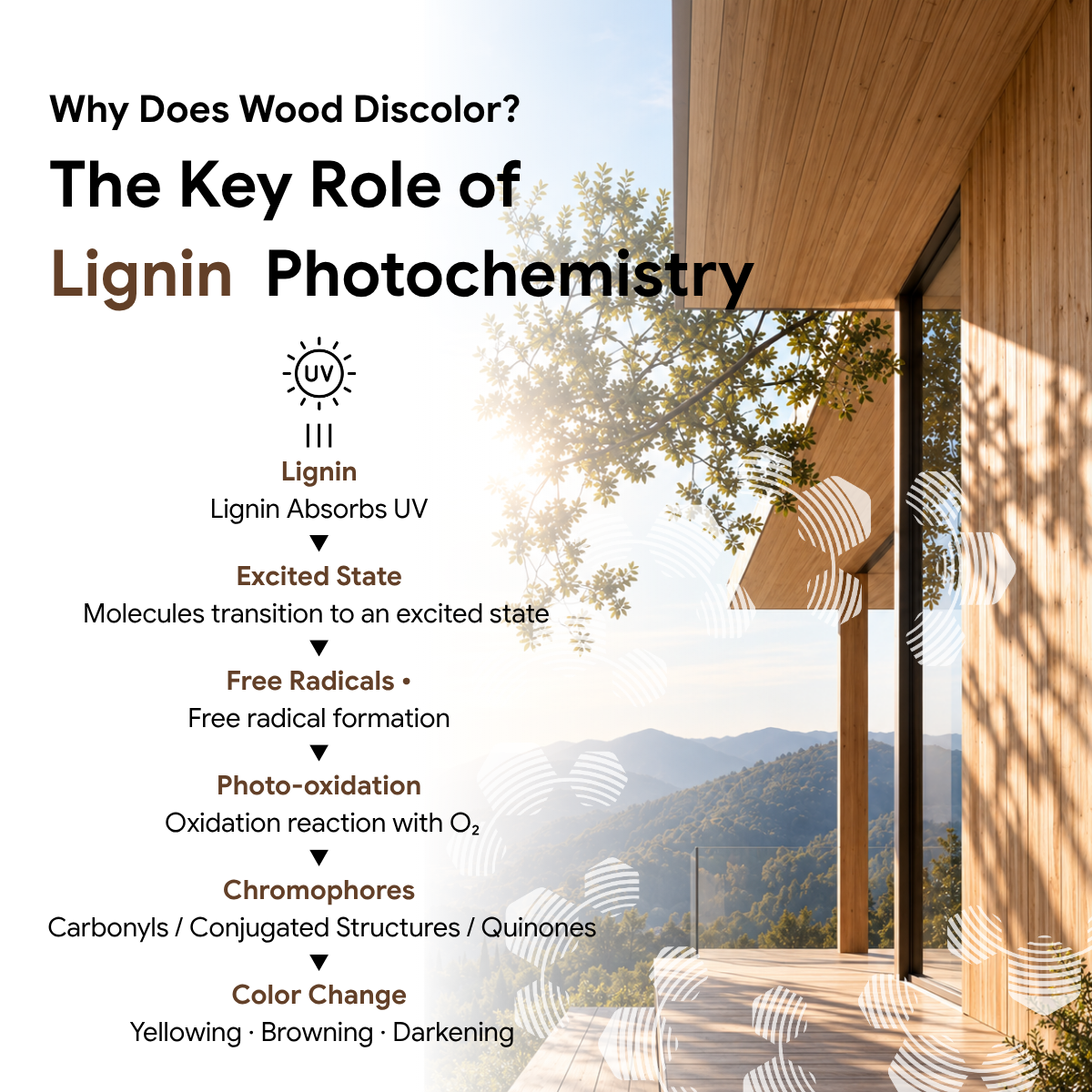
Wood is composed primarily of cellulose, hemicellulose, and lignin—among which lignin is the most light-sensitive component responsible for wood photodegradation.
Lignin contains light-absorbing chromophores such as aromatic rings, phenolic hydroxyl groups, carbonyl groups, and conjugated double bonds. Upon UV irradiation, these structures transition into excited states, triggering bond scission, hydrogen abstraction, and electron transfer reactions that generate highly reactive free radicals.
The overall photodegradation pathway can be summarized as follows:
A 2026 comprehensive review in Polymers stated that UV aging of wood and wood coatings involves polymer chain scission, structural rearrangement, and photo-oxidation of lignin alongside other wood components. As aging progresses, it manifests macroscopically through discoloration, loss of gloss, chalking, and cracking. ( MDPI )
Free radicals are therefore not merely late-stage byproducts of photo-aging; they serve as critical reactive intermediates linking initial light energy absorption to subsequent oxidation chain reactions.
As radical generation continues, photo-oxidation propagates throughout the material, promoting the formation of carbonyls, conjugated structures, and quinoid chromophores that cause progressive color shift.
For wood coating formulations, a comprehensive protection strategy must therefore aim beyond simple "anti-yellowing" to deliver true Color Retention.
Wood Greying: The Five-Stage Weathering Process
Yellowing, fading, greying, and surface erosion represent distinct manifestations of wood weathering under the combined action of UV radiation, oxygen, rainwater, and environmental cycles.
Initial exposure primarily triggers photochemical reactions in lignin and extractives, resulting in early color changes. With continued exposure, photo-degraded lignin yields lower-molecular-weight degradation products that are gradually leached out by rain, dew, and wet-dry cycles.
As surface chemical composition alters alongside moisture variations, wind erosion, and biological factors, the wood transitions from initial yellowish-brown discoloration to fading, greying, and ultimately surface checking, fiber raising, and mechanical erosion.
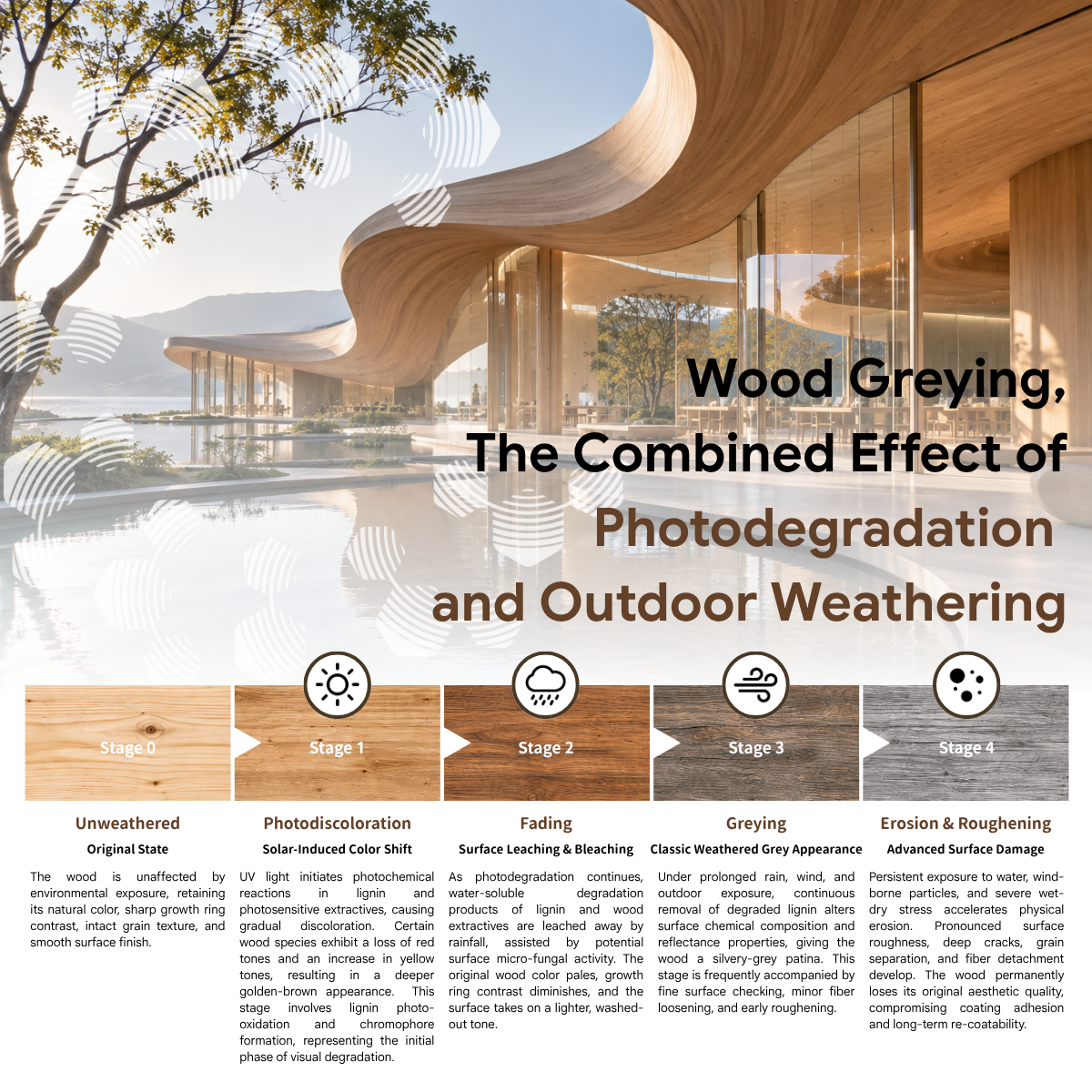
Based on visual and structural surface changes, typical outdoor wood weathering can be conceptually classified into five stages:
The wood is unaffected by environmental exposure, retaining its natural color, sharp growth ring contrast, intact grain texture, and smooth surface finish.
UV light initiates photochemical reactions in lignin and photosensitive extractives, causing gradual discoloration. Certain wood species exhibit a loss of red tones and an increase in yellow tones, resulting in a deeper golden-brown appearance.
This stage involves lignin photo-oxidation and chromophore formation, representing the initial phase of visual degradation.
As photodegradation continues, water-soluble degradation products of lignin and wood extractives are leached away by rainfall, assisted by potential surface micro-fungal activity.
The original wood color pales, growth ring contrast diminishes, and the surface takes on a lighter, washed-out tone.
Under prolonged rain, wind, and outdoor exposure, continuous removal of degraded lignin alters surface chemical composition and reflectance properties, giving the wood a silvery-grey patina.
This stage is frequently accompanied by fine surface checking, minor fiber loosening, and early roughening.
Persistent exposure to water, wind-borne particles, and severe wet-dry stress accelerates physical erosion. Pronounced surface roughness, deep cracks, grain separation, and fiber detachment develop.
The wood permanently loses its original aesthetic quality, compromising coating adhesion and long-term re-coatability.
These five stages serve as a conceptual framework for outdoor wood weathering; actual progression rates and characteristics depend heavily on timber species, extractive content, coating formulation, and local exposure conditions.
The Core Challenge in Clear Wood Coatings: Balancing Transparency and Light Protection
Opaque paints utilize pigments to absorb, reflect, or scatter incoming radiation, but clear wood finishes must remain transparent to highlight natural wood grain, ruling out heavy reliance on opaque pigments.
This creates a fundamental material design trade-off: maximizing visible light transmission while suppressing high-energy UV damage to both coating film and wood substrate.
UV radiation induces free radical formation and photo-oxidation within the coating resin itself, leading to polymer backbone scission, crosslinking alterations, and surface degradation. Therefore, a complete light stabilization strategy for clear wood coatings must concurrently protect three distinct levels: the coating film, the coating/wood interface, and the wood substrate.
UVA & HALS: Dual-Stage Control of Photo-Aging
To effectively suppress photo-aging in wood coatings, the most robust approach targets both reaction initiation and chain propagation.
UV Absorbers (UVA): Mitigating Reaction Initiation
UV Absorbers preferentially absorb harmful ultraviolet radiation, converting high-energy photon energy into harmless thermal energy before it can excite chromophores in the resin or underlying lignin.
The primary mode of action for UVAs is not direct radical scavenging, but rather:
Reducing UV Energy Input → Suppressing Chromophore Excitation → Minimizing Free Radical Generation
UVA performance governed by spectral absorption range, concentration, and film thickness can be understood through the Beer-Lambert Law:
Where Absorbance (A) depends on molar absorptivity (ε), path length/film thickness (b), and concentration (c).
In practical formulations, adding a UVA does not imply total UV blockage; performance depends on intrinsic absorption efficiency, loading, dry film thickness, resin compatibility, and photo-permanence.
Hindered Amine Light Stabilizers (HALS): Inhibiting Radical Propagation
HALS operate via a distinct mechanism.
Unlike UVAs, HALS do not rely on absorbing UV radiation; instead, they intervene in photo-oxidation chain reactions after free radicals have already formed.
The stabilizing action of HALS is widely described by the Denisov Cycle. In photo-oxidative environments, HALS convert into active nitroxyl radicals (N-O•) that scavenge alkyl and alkylperoxy radicals, regenerating active stabilizing species throughout the catalytic cycle.
Thus, HALS are best defined as: Regenerative free radical scavengers that interrupt the propagation of photo-oxidation chain reactions.
The 2026 review in Polymers reconfirmed the Denisov Cycle of HALS as a fundamental stabilization mechanism in advanced wood coating formulations. ( MDPI )
Modern wood coating stabilization is increasingly shifting from single-additive protection to multi-mechanism synergy. Synergistic blends combining UVAs and HALS represent a key direction for maximizing exterior coating durability. ( MDPI )
Research Insights: Why Single-Additive Protection Is Insufficient
A 2025 review on outdoor water-based clear wood finishes stressed that promising modern strategies involve hybrid nanocomposites, surface modification, and multifunctional additive systems designed to enhance UV protection, mechanical integrity, and weatherability without sacrificing clarity. ( ScienceDirect )
Furthermore, outdoor field data compiled in the study revealed that conventional clear wood coatings in temperate climates often experience coating failure within 2 years, while in tropical regions, failure can occur in as little as 1 year. This underlines that the primary engineering obstacle for clear wood finishes is long-term weatherability rather than initial appearance. ( ScienceDirect )
The 2026 literature further emphasizes that anti-aging coating design is actively advancing toward synergistic combination systems utilizing UVAs, HALS, antioxidants, and screening agents to simultaneously inhibit photochemical initiation and free radical propagation. ( MDPI )
Chiguard® Wood Series: Blended UVA + HALS Light Stabilization Solutions
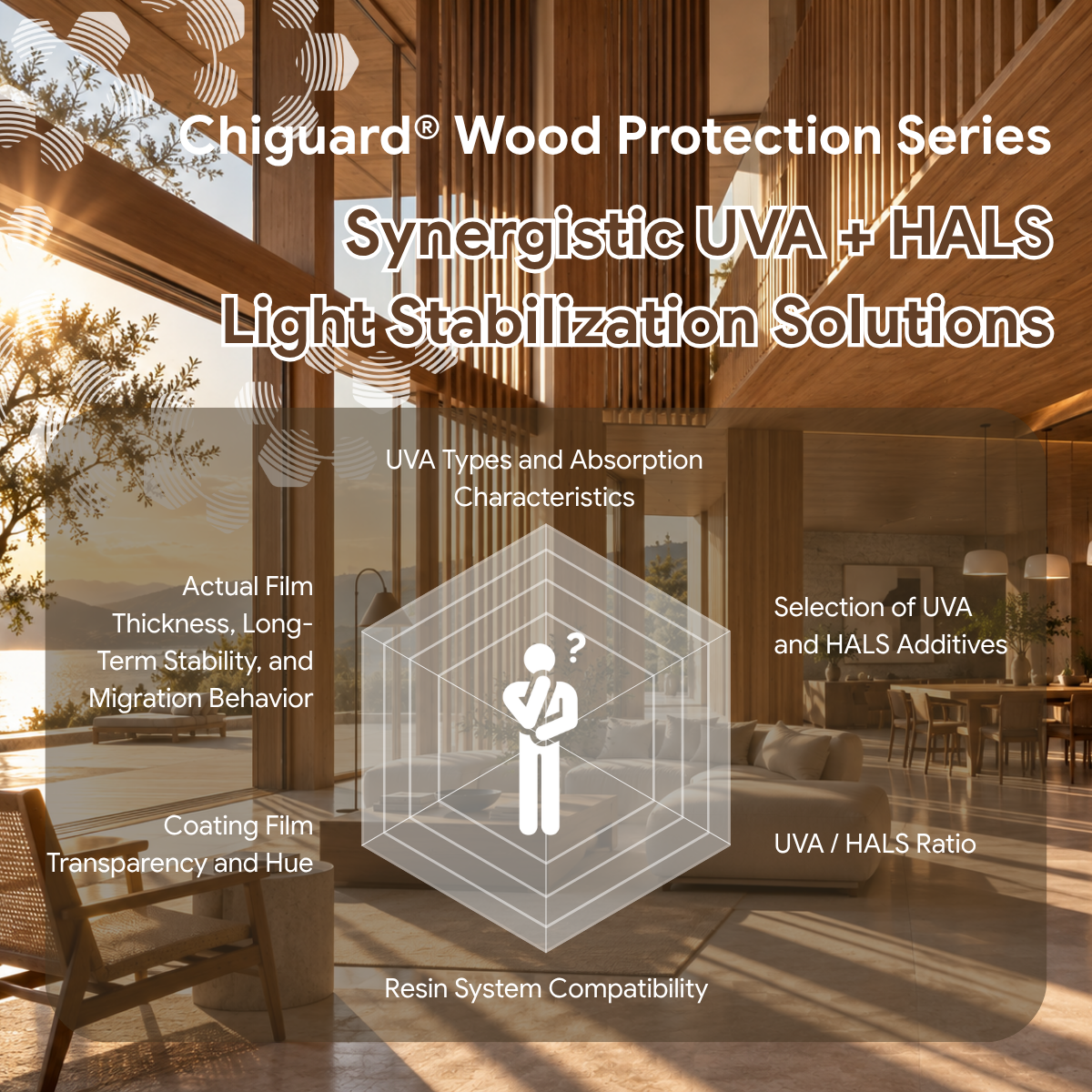
For wood coating formulation chemists, the key challenge is rarely deciding whether to use UVA and HALS together, but rather engineering a perfectly optimized blend for specific resin systems.
Formulation development requires balancing multiple variables: UVA absorption chemistry, HALS basicity and structure, optimal UVA/HALS ratio, resin compatibility, clarity, initial color, film thickness, and resistance to migration or volatilization.
To resolve these complex formulation demands, Chiguard® Wood Series solutions offer pre-formulated UVA + HALS synergistic blends that integrate complementary UV absorption and radical scavenging mechanisms into a single package. The dual-action system operates on two core levels:
UVA Component: Reduces Initial Free Radical Formation
Absorbs harmful UV radiation to minimize photon excitation of resin and substrate, reducing radical initiation at the source.
HALS Component: Prevents Radical Chain Propagation
Efficiently scavenges free radicals generated within the system, suppressing continuous photo-oxidation propagation.
Through this dual mechanism, the Chiguard® Wood Series delivers robust, long-lasting light protection: UV absorption, radical suppression, and catalytic free radical scavenging.
Applications
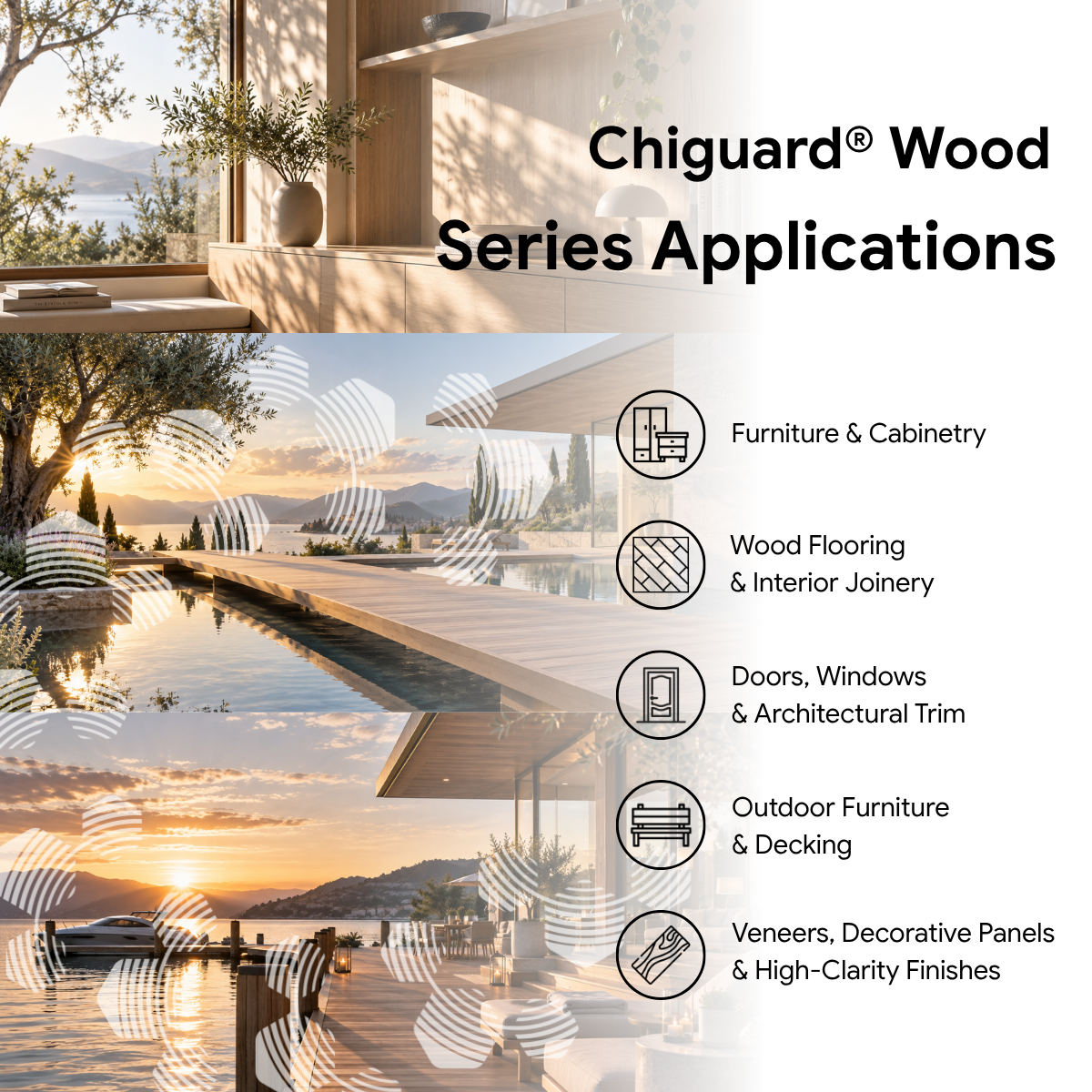
The synergistic UVA + HALS stabilization technology of the Chiguard® Wood Series is ideal for wood coating applications requiring high clarity, color retention, and weatherability. Specific addition levels should be validated based on resin type, wood species, film thickness, application method, and target exposure conditions.
Tables, chairs, cabinets, and interior woodwork exposed to window sunlight or artificial light are susceptible to yellowing and color shift. Light-colored or pale woods show discoloration easily, making long-term color retention a critical quality metric.
Large-area wood floors often develop uneven shade differences between sunlit and shaded areas. Premium floor coatings require superior light stability and color retention alongside scratch and abrasion resistance.
Exterior doors, window frames, and exterior trim experience simultaneous UV, oxygen, moisture, and thermal stress. Coatings must prevent wood discoloration while resisting gloss loss, embrittlement, and cracking.
Patio furniture, decking, railings, siding, and landscaping timber endure severe weathering. Formulations require balanced light protection, moisture resistance, and film integrity.
High-end veneers and decorative wood panels designed to highlight natural grain patterns cannot rely on opaque screening pigments, demanding high-performance clear light stabilizers to maintain long-term aesthetics.

References
Xia, M.; Gao, H.; Feng, X.; Liu, X. Photodegradation Mechanisms and Anti-Aging Strategies of Wood Coatings: A Comprehensive Review. Polymers, 2026, 18(9), 1090. ( MDPI )
Jorbandian, A.; Ashori, A.; Jonoobi, M. High-performance and sustainable clear water-based coatings for outdoor wood protection: A review. Progress in Organic Coatings, 2025, 109452. ( ScienceDirect )
建議您使用以下瀏覽器觀看本網站,
要下載瀏覽器,請直接點擊以下:以獲得最佳瀏覽效果。