
How Are Plastics Driving the Next Generation of Robotics?
From Head-Mounted Sensors to Precision Joints: How Polymer Materials Enable Next-Generation Robotics
From Polymers to Robotics: Engineering Materials for the Next Generation of Robots
As Robots Become Smarter, Materials Must Evolve Too
When we think of robots, artificial intelligence, advanced chips, sensors, and motors often come to mind first. Yet behind the integration of these technologies into a machine capable of sensing, moving, and performing tasks lies another essential element: polymer materials.
From transparent sensor covers in the head and electronic control modules in the torso to arm joints, precision gears, electrical connectors, and protective foot components, plastics have become integral to nearly every functional system in a robot.
The value of plastics goes far beyond weight reduction. With their mechanical strength, heat resistance, dimensional stability, electrical insulation, and design and processing flexibility, engineering plastics help integrate increasingly complex functions within the limited space available inside a robot.
As robots move from research prototypes into real-world applications, however, the demands placed on these materials are also increasing.
Robots can become smarter, but their materials must first be stable enough.
This is why high-performance engineering plastics and material stabilization technologies deserve continued attention as the next generation of robotics takes shape.

| From Smart Manufacturing to Humanoid Robots: Robotics Expands into New Applications
The robotics industry is undergoing a transition from standalone automation equipment to highly integrated intelligent systems.
In conventional manufacturing, industrial robots are widely used for welding, material handling, assembly, and quality inspection. As artificial intelligence, machine vision, sensing technologies, and autonomous control continue to advance, robotic applications are expanding into smart logistics, healthcare, commercial services, agriculture, and outdoor inspection.
The development of humanoid robots, in particular, is driving further advances in mechanical structures and material design.
Compared with traditional stationary industrial robots, humanoid robots must accommodate more sensors, motors, actuators, controllers, power systems, and precision transmission components within a confined body, while balancing lightweight design, mechanical strength, mobility, and energy efficiency.
From BMW's testing of humanoid robots in automotive manufacturing to Agility Robotics' commercial deployment initiatives for Digit in logistics and manufacturing, and NVIDIA's continued development of Physical AI and robotics simulation and training platforms, the industry is gradually bringing robotic technologies into real working environments.
As robots require more precise movement, greater system integration, and more consistent manufacturing quality, their materials must not only meet component-level functional requirements but also withstand increasingly complex processing and operating conditions.
| Anatomy of a Robot: Polymer Applications from Head to Toe
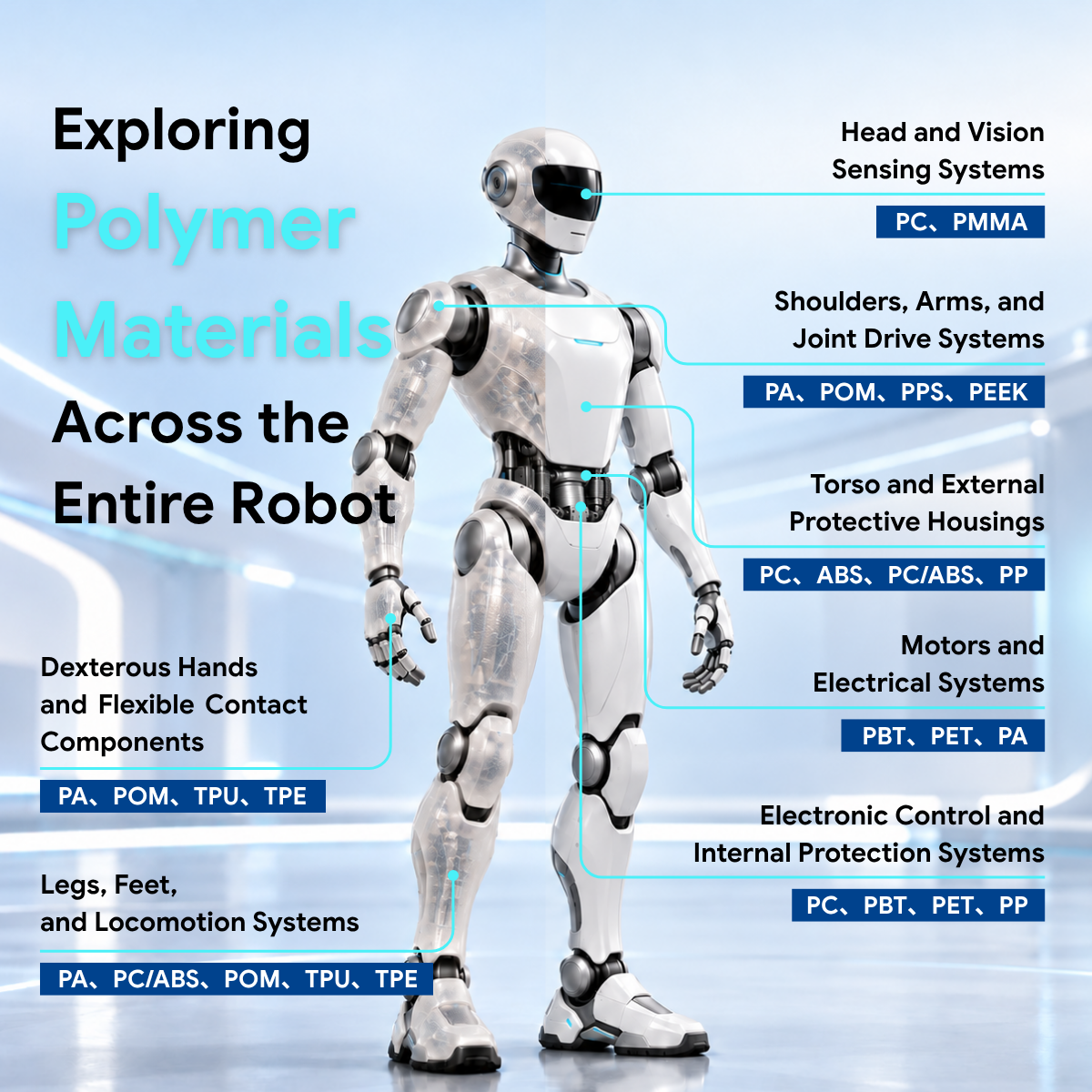
A robot is a complex machine integrating sensing, computing, actuation, transmission, and electrical systems.
Each part has distinct functional requirements, so material selection must consider optical performance, mechanical strength, heat resistance, wear resistance, electrical insulation, processing stability, and the operating environment.
Head and Vision Systems: PC, PMMA
A robot's head typically integrates cameras, 3D sensors, display interfaces, LED status indicators, and other optical components, making it essential for environmental perception and human–robot interaction.
Depending on their optical and mechanical properties, polycarbonate (PC) and polymethyl methacrylate (PMMA) may be used for camera module housings, transparent protective covers, sensor enclosures, and peripheral optical components.
PC offers good impact resistance, while PMMA provides excellent optical clarity. Actual material selection must still be evaluated against the sensor's operating wavelength range, mechanical requirements, and service environment.
For transparent, white, and light-colored parts, initial material color and appearance after processing are especially important.
High-temperature processing may trigger polymer oxidation, resulting in yellowing and changes in material quality. In addition, the inherent color of additives may affect the appearance consistency of finished components.
Antioxidant systems offering low initial color and good processing stability are therefore worth evaluating for these materials.
Torso and Exterior Protective Housings: PC, ABS, PC/ABS, PP
The housings covering a robot's chest, back, arms, and legs not only define its appearance but also protect internal electronic modules, wiring, and mechanical structures.
Materials such as PC, ABS, PC/ABS, and PP can be selected according to impact resistance, rigidity, weight, processability, and cost requirements.
For example, PC/ABS is a candidate for housings that must balance impact resistance with moldability, while PP may be used for lightweight protective covers, cable fasteners, and non-load-bearing internal plastic parts, depending on design requirements.
As robots enter outdoor delivery, agricultural, and inspection applications, their external plastic components may be exposed to ultraviolet radiation, heat, and moisture for extended periods.
These conditions may lead to yellowing, fading, loss of gloss, and deterioration of mechanical properties.
In addition to processing stability, exterior protection materials may therefore benefit from ultraviolet absorbers (UVAs) and hindered amine light stabilizers (HALS), selected according to the service environment, as part of a more comprehensive protection strategy.
Shoulders, Arms, and Joint Transmission Systems: PA, POM, PPS, PEEK
Shoulders, arms, elbows, knees, and other joint systems are essential for precise robotic motion and load control.
These assemblies may contain gears, bushings, sliding elements, bearing cages, fasteners, and other mechanical structural components.
Engineering plastics such as polyamide (PA), polyoxymethylene (POM), polyphenylene sulfide (PPS), and polyether ether ketone (PEEK) may be considered according to mechanical strength, wear resistance, heat resistance, dimensional precision, and cost.
PA66, in particular, offers good mechanical properties and formulation flexibility. Glass-fiber reinforcement, flame retardancy, wear resistance, lubrication, and heat stabilization technologies can be incorporated to meet the needs of different components.
However, when multiple functions are combined within a single material system, additive efficiency and formulation compatibility also affect the available design flexibility.
Especially during high-temperature compounding, extrusion, and injection molding, minimizing oxidative degradation while maintaining consistent processing quality is a key challenge in engineering plastics development.
Dexterous Hands and Flexible Contact Components: PA, POM, TPU, TPE
Dexterous hands are an important technology enabling humanoid robots to perform fine manipulation tasks.
To grasp, rotate, press, and manipulate objects, dexterous hands typically combine rigid structures, precision transmission mechanisms, sensors, and flexible contact materials.
Engineering plastics such as PA and POM may be used in precision mechanisms and support components, while thermoplastic polyurethane (TPU) and thermoplastic elastomers (TPE) are candidate materials for fingertip contact pads, flexible protective layers, and other elastic parts.
In addition to meeting mechanical performance requirements, these materials may face repeated bending, friction and wear, thermo-oxidative degradation, and environmental exposure.
Because resin chemistries and aging mechanisms vary, stabilizer selection must be evaluated based on the material type, processing conditions, and final performance requirements.
Motors and Electrical Systems: PBT, PET, PA
Robotic motors, actuators, and electrical systems require numerous precision plastic parts, including connectors, insulating components, electrical interconnects, and structural parts surrounding motors.
Engineering plastics such as polybutylene terephthalate (PBT), polyethylene terephthalate (PET), and PA may be selected according to heat resistance, electrical insulation, dimensional stability, and mechanical performance requirements.
These materials generally undergo processes such as compounding, extrusion, or injection molding.
As processing temperatures rise, exposure to heat and oxygen may cause oxidative degradation, affecting color, melt flow behavior, and quality consistency.
Appropriate antioxidant stabilization technology can therefore play an important role in developing formulations for precision electrical components.
Electronic Control and Internal Protection Systems: PC, PBT, PET, PP
A robot's electronic control system integrates controllers, sensors, power management modules, structures surrounding batteries, and extensive wiring.
Depending on their functional requirements, PC, PBT, PET, and PP may be used in controller housings, electronic module structures, electrical insulation films, cable fasteners, and internal protective parts.
PET films and related materials may also be considered for electrical insulation, flexible electronics, and applications associated with flexible flat cables (FFCs).
For PET subjected to multiple processing cycles, accumulated thermal history may cause yellowing and changes in melt flow behavior, affecting quality consistency across processing stages and production batches.
Improving PET's oxidation resistance and color retention during repeated processing is therefore a material development direction worth exploring.
Legs, Feet, and Mobility Systems: PA, PC/ABS, POM, TPU, TPE
The legs and feet of humanoid robots are key areas subjected to dynamic loads and must balance structural strength, impact resistance, dimensional stability, and friction control.
Depending on design requirements, PA, POM, and PC/ABS may be used for mechanical and protective components, while elastomeric materials such as TPU and TPE are candidates for certain contact pads and flexible protective parts.
Beyond the inherent mechanical properties of these materials, components may also face sustained thermal loads, cyclic fatigue, wear, and outdoor exposure.
Material development must therefore consider resin selection, structural design, and suitable stabilizer technologies together.
| As Material Performance Advances, Processing Stability Becomes a New Technical Challenge
From head-mounted sensors to precision joints, engineering plastics enable robots to combine lightweight construction, functional integration, and component design flexibility.
Yet transforming resin into precision components often involves multiple processing stages, including compounding, pelletizing, extrusion, and injection molding.
As engineering plastics evolve toward higher heat resistance and more complex formulations, processing conditions may become more demanding.
Under heat and oxygen exposure, polymers may undergo oxidation, resulting in yellowing, changes in melt flow behavior, and reduced material quality.
For transparent, white, and light-colored materials, these changes can affect appearance. For precision structural and electrical components, processing stability is closely tied to process control and consistent quality.
Therefore, beyond choosing the right engineering plastic, using antioxidant technology to reduce oxidative degradation during processing has become an important consideration in formulation design.
| Revonox® 608: Processing Antioxidant Solutions for Next-Generation Robotics Plastics
As robotic components advance toward higher precision, greater heat resistance, and deeper integration, material stabilizers must also meet more demanding processing conditions.
Chitec Technology's Revonox® 608 is a high-performance phosphite antioxidant characterized by high-temperature processing stability, good hydrolytic stability, and low initial color.
According to Chitec Technology's existing product information, Revonox® 608 may be considered as an antioxidant solution for polymer systems including PC, PET, PA, PMMA, PBT, and PP, helping material developers evaluate oxidative degradation and quality stability during processing.
High Thermal Stability for Demanding Processing Conditions
As engineering plastic processing temperatures increase, antioxidants themselves must provide sufficient thermal stability.
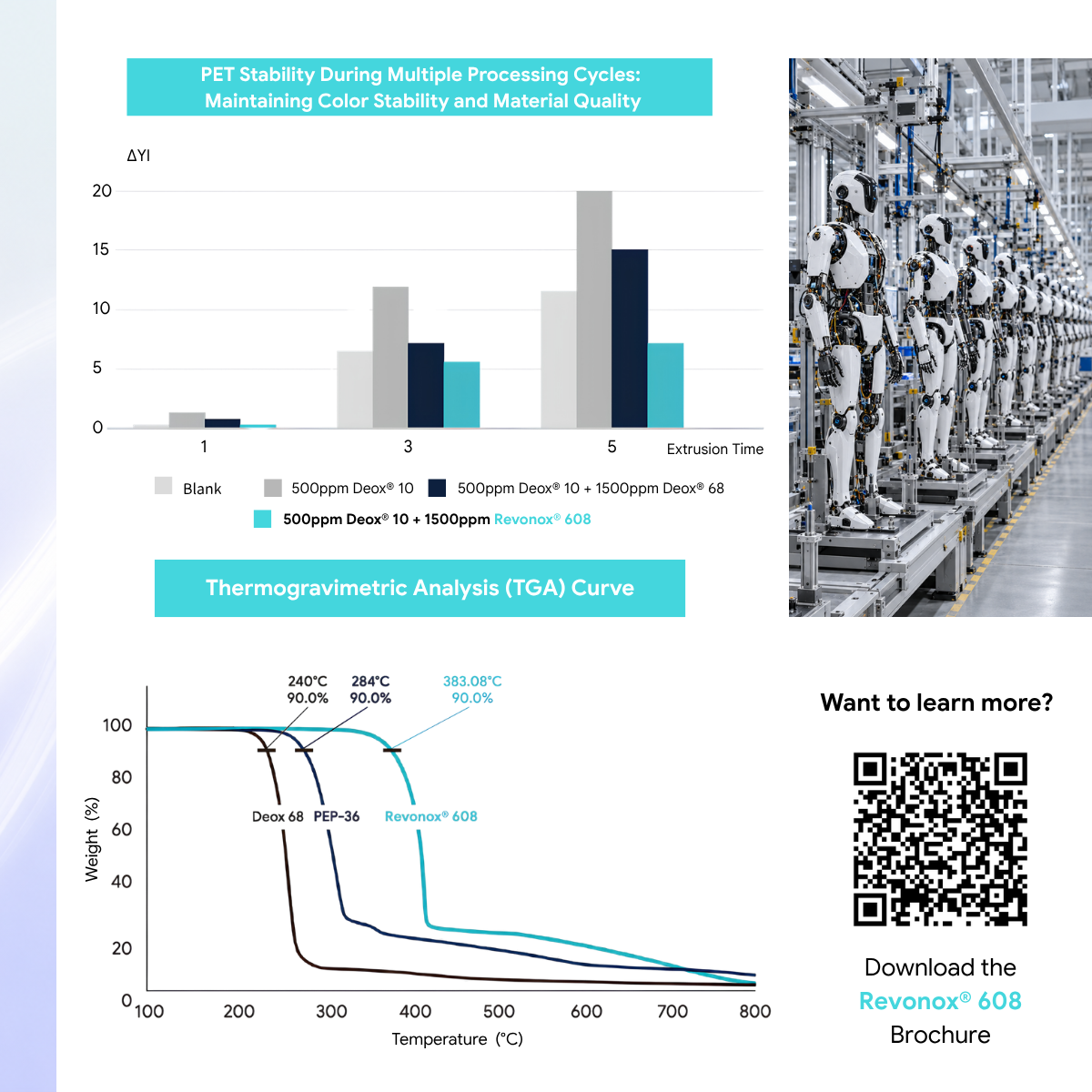
Thermogravimetric analysis (TGA) of Revonox® 608 shows a temperature of 383.08°C at 10% weight loss, demonstrating good high-temperature thermal stability.
This property makes Revonox® 608 an antioxidant candidate worth evaluating in high-temperature engineering plastic formulations.
It is important to note that the TGA weight-loss temperature is an indicator of an additive's thermal behavior and does not directly represent the recommended processing temperature for every resin system. Actual use must be validated according to the resin, residence time, formulation, and processing conditions.
Good Hydrolytic Stability to Address Challenges in Phosphite Applications
Phosphite antioxidants help inhibit oxidative degradation during polymer processing through mechanisms including the decomposition of hydroperoxides.
However, conventional phosphites may undergo hydrolysis when exposed to moisture, reducing their stabilizing effectiveness.
Revonox® 608 is designed with an emphasis on improved hydrolytic stability of the antioxidant itself, reducing the impact of moisture on the phosphite and providing more stabilization design options for engineering plastic formulations.
The hydrolytic stability of an antioxidant should not be confused with the hydrolysis resistance of the base polymer; the two must be evaluated separately.
Low Initial Color: Balancing Antioxidant Protection and Appearance
For transparent sensor covers, camera module housings, display protective layers, LED covers, and white exterior components, material color is an important quality indicator.
In addition to yellowing that may occur during resin processing, the inherent initial color of an additive can affect the appearance of the final component.
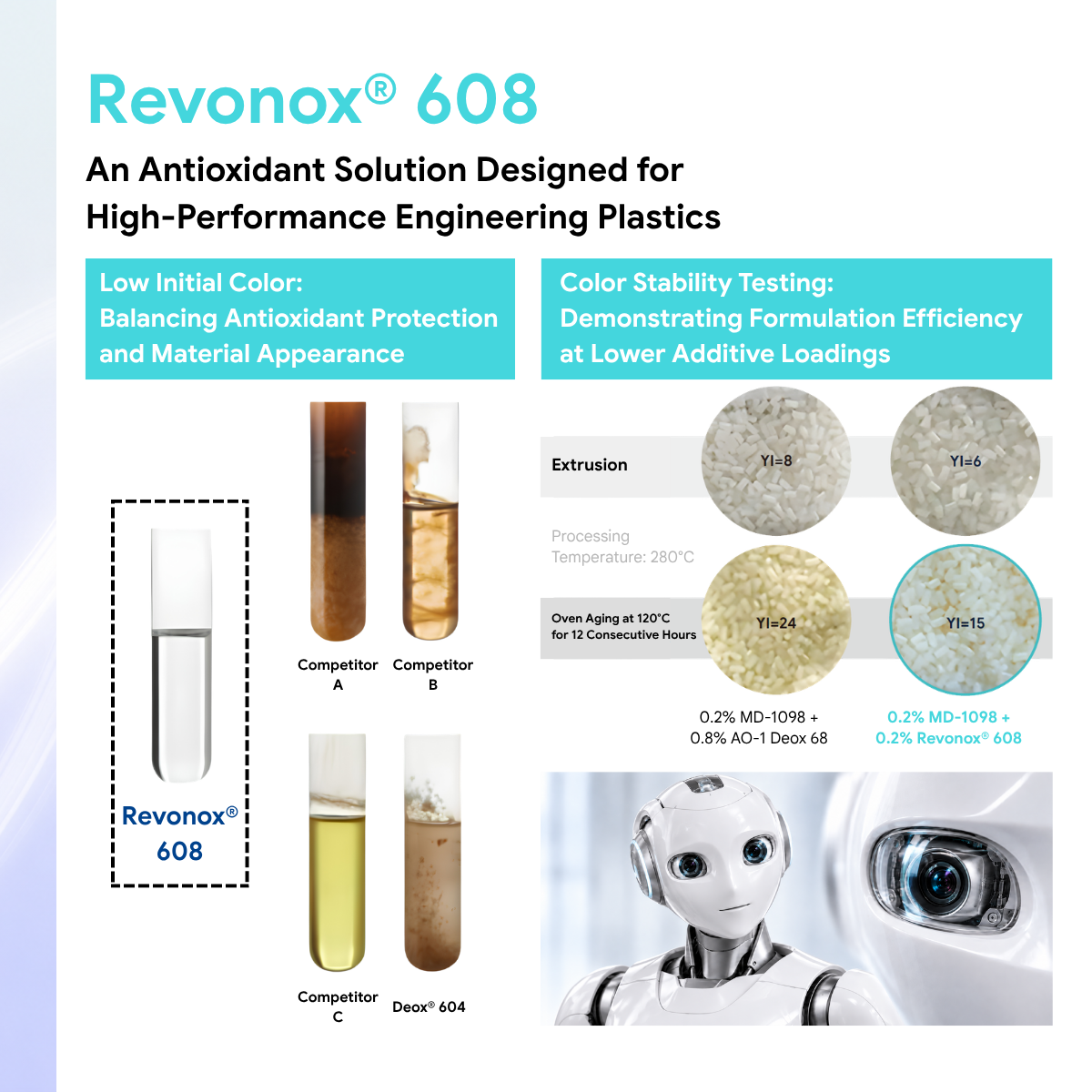
Revonox® 608 features low initial color.
Under Chitec Technology's comparative melt-color test conditions of 280°C for 2 hours, Revonox® 608 exhibited a clear, low-color appearance and lower initial coloration than certain comparison products.
This property makes it worth evaluating in transparent, white, and light-colored polymer formulations to help minimize the effect of the antioxidant's inherent color on material appearance.
For actual optical components, further validation of light transmittance, haze, yellowness index, and other relevant optical properties is still required.
PET Stability Through Multiple Processing Cycles: Preserving Color and Material Quality
Depending on material design, PET may be used in robotic electrical insulation films, flexible-electronics-related materials, battery and power-system insulation, and FFC-related insulating materials.
When PET undergoes compounding, pelletizing, extrusion, and subsequent processing, its accumulated thermal history may cause yellowing and changes in melt flow behavior.
A formulation containing 500 ppm Deox® 10 + 1,500 ppm Revonox® 608 demonstrated good color retention and melt flow stability under the tested conditions.
These results indicate that Revonox® 608 may serve as an antioxidant solution for PET stability across multiple processing cycles, helping material developers evaluate ways to reduce quality changes caused by repeated thermal processing.
PA66 Color-Retention Testing: Formulation Efficiency at a Lower Loading
Depending on design and formulation requirements, PA66 may be used for robotic gears, bushings, sliding elements, bearing cages, connector housings, and other mechanical structural parts.
To meet requirements for mechanical strength, wear resistance, flame retardancy, lubrication, and heat resistance, PA66 formulations may incorporate multiple functional additives.
In the PA66 comparison test, both formulations contained 0.2% MD-1098, with one using 0.8% Deox® 68 and the other using 0.2% Revonox® 608.
| Test Parameter | Formulation with 0.8% Deox® 68 | Formulation with 0.2% Revonox® 608 |
|---|---|---|
| Processing Temperature | 280°C | 280°C |
| Yellowness Index (YI) After Extrusion | 8 | 6 |
| YI After Oven Aging at 120°C for 12 Hours | 24 | 15 |
Under these specific test conditions, Revonox® 608 achieved a lower yellowness index at only one-quarter of the comparison antioxidant's loading.
This result suggests that Revonox® 608 offers color-retention efficiency worth further evaluation and may provide greater additive design flexibility for complex PA66 formulations.
For engineering plastics requiring reinforcement, flame retardancy, wear resistance, and other functional features, a lower antioxidant loading may also allow more room for formulation adjustments.
| Exploring Revonox® 608 Opportunities Based on Robotics Material Requirements
Based on the properties of Revonox® 608 and existing material application information, the following robotic components may be prioritized for technical evaluation.
| Robotic Functional System | Candidate Materials | Key Components | Revonox® 608 Evaluation Focus |
|---|---|---|---|
| Vision and Sensing Systems | PC, PMMA | Camera module housings, transparent covers, sensor enclosures | Low initial color, processing oxidation resistance |
| Electronics and Control Systems | PC, PBT, PET | Controller housings, electrical interconnects, electronic module structures | High-temperature processing and color stability |
| Joint and Motion Systems | PA | Gears, bushings, sliding elements, mechanical structural parts | Processing stability, color-retention efficiency |
| Motors and Electrical Systems | PBT, PET | Connectors, insulating parts, electrical interconnects | Antioxidant protection and processing quality control |
| Lightweight and Protective Components | PP, PC | Protective covers, cable fasteners, non-load-bearing internal parts | Processing stability and appearance quality |
Because processing temperatures, additive compatibility, and performance requirements differ among resins, each application must be tested individually before implementation.
In addition, Revonox® 608 is suitable for evaluation in polymer systems processed at relatively high temperatures. It is not recommended for direct use in lower-processing-temperature materials such as PE and PU; more suitable stabilization technologies should be selected instead.
| Beyond Revonox® 608: Exploring Stabilizer Opportunities Across More Robotics Materials
Robotics material requirements extend beyond PC, PET, PA, PMMA, PBT, and PP.
As robots expand into more diverse applications, ABS, PC/ABS, ASA, POM, PPS, PEEK, TPU, TPE, and various coating systems may also become important areas of material development.
For example, PC/ABS may be considered for exterior protective housings; POM, PPS, and PEEK for precision moving parts according to mechanical and thermal requirements; and TPU and TPE for certain flexible contact components, protective layers, and elastic parts.
Beyond Revonox® 608, Chitec can also help customers evaluate other antioxidants and light stabilization technologies based on different resin systems and application conditions.
Outdoor Robots: Opportunities for Chiguard® UV Absorbers and HALS
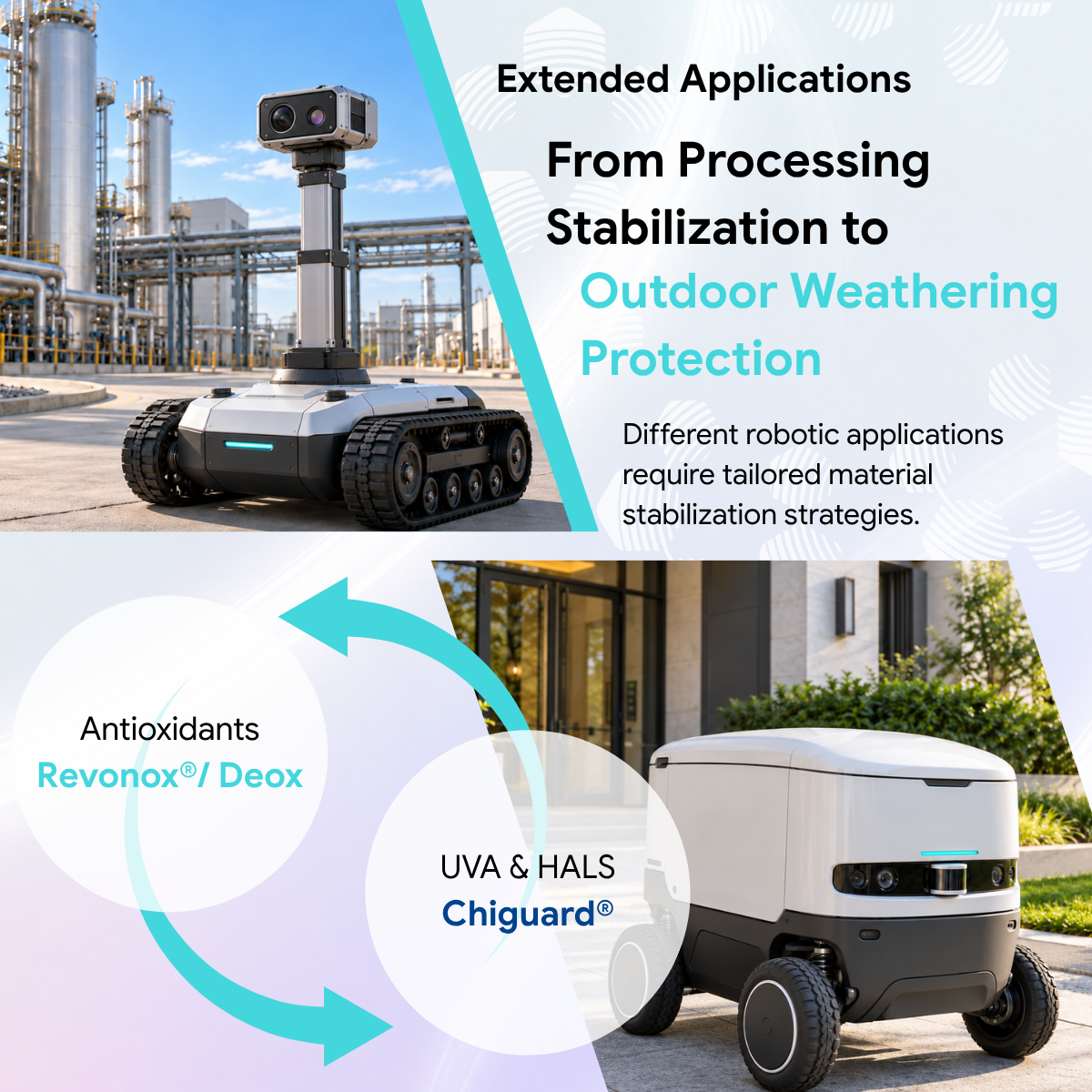
For outdoor delivery robots, agricultural robots, inspection robots, and other equipment exposed to sunlight for extended periods, ultraviolet radiation may accelerate the photo-oxidative degradation of certain polymer materials.
Depending on material properties and formulation requirements, Chiguard® ultraviolet absorbers (UVAs) and HALS light stabilization technologies may be evaluated to help improve the light resistance and weatherability of suitable materials.
Actual selection must still account for resin compatibility, processing temperature, optical requirements, and weathering test results.
As robots move beyond factories into more diverse operating environments, the role of materials is changing.
Polymers are no longer simply options for lightweight construction and structural design; they are a critical foundation for precision sensing, electrical integration, mechanical motion, and product reliability.
For material developers, the real challenge is not just choosing the right resin, but maintaining consistent quality during processing while meeting the performance demands of different operating environments.
With its high thermal stability, good hydrolytic stability, and low initial color, Revonox® 608 offers a processing antioxidant solution worth evaluating for engineering plastics used in robotics.
At the same time, Chitec continues to offer a range of antioxidant and light stabilization technologies for outdoor applications, transparent materials, flexible components, and other high-performance plastics, helping customers explore stabilization strategies for different material systems.
Partner with Chitec Technology to Explore New Possibilities in Next-Generation Robotics Materials
Whether you aim to improve high-temperature processing stability, reduce yellowing, increase formulation flexibility, or evaluate long-term weathering protection, Chitec welcomes the opportunity to discuss your material applications and technical challenges.
Chitec Technology — Sustainable Additives, Better Future
建議您使用以下瀏覽器觀看本網站,
要下載瀏覽器,請直接點擊以下:以獲得最佳瀏覽效果。